Friday, August 5, 2022


                             Nationalism in India

NCERT Solutions – Social Science History Chapter 2

Exercise Page No. 50

Write in Brief:

1. Explain:

a. Why the growth of nationalism in the colonies is linked to an anti-colonial movement.

Answer:

  1. People began discovering their unity in the process of their struggle with colonialism.
  2. The sense of being oppressed under colonialism provided a shared bond that tied many different groups together.
  3. But each class and group felt the effects of colonialism differently. Their experiences were varied and their notions of freedom were not always the same. The Congress under Mahatma Gandhi tried to forge these groups together within one movement. But the unity did not emerge without conflict.

b. How the First World War helped in the growth of the National Movement in India.

Answer:

War created a new political and economic situation.

  1. Led to a huge increase in defence expenditure which was financed by war loans and increasing taxes: custom duties were increased and income tax introduced.
  2. Forced recruitment in villages caused widespread anger.
  3. Crops failed; this resulted in an acute shortage of food.
  4. 12 to 13 million people died due to famines and epidemics.

c. Why Indians were outraged by the Rowlatt Act.

Answer:

  1. Rowlatt Act was introduced in 1919.
  2. This act was hurriedly passed through the Imperial Legislative Council, although it was completely opposed by Indian members.
  3. It had given the Government enormous powers to repress political activities.
  4. It allowed detention of political prisoners without trial for two years.

d. Why Gandhiji decided to withdraw the Non-Cooperation Movement.

Answer:

In February 1922, Mahatma Gandhi decided to withdraw the Non-Cooperation Movement. He felt the movement was turning violent in many places, and satyagrahis needed to be properly trained before they would be ready for mass struggles.

2. What is meant by the idea of satyagraha?

Answer:

The idea of satyagraha emphasised the power of truth and the need to search for truth. It suggested that if the cause was true, if the struggle was against injustice, then the physical force was not necessary to fight the oppressor. Without seeking vengeance or being aggressive, a satyagrahi could win the battle through nonviolence. This could be done by appealing to the conscience of the oppressor. People – including the oppressors – had to be persuaded to see the truth, instead of being forced to accept truth through the use of violence. By this struggle, the truth was bound to triumph ultimately. Mahatma Gandhi believed that this dharma of non-violence could unite all Indians.

3. Write a newspaper report on

a) The Jallianwala Bagh massacre

Answer:

On 13 April, the infamous Jallianwalla Bagh incident took place. On that day a large crowd was gathered in the enclosed ground of Jallianwalla Bagh. Some came to protest against the government’s new repressive measures. Others had come to attend the annual Baisakhi fair. Being from outside the city, many villagers were unaware of the martial law that had been imposed. Dyer entered the area, blocked the exit points, and opened fire on the crowd, killing hundreds. His objective, as he declared later, was to ‘produce a moral effect’, in the minds of Satyagrahis. A feeling of terror and awe.

b) The Simon Commission

Answer:

When the Simon Commission arrived in India in 1928, it was greeted with the slogan ‘Go back, Simon’. All parties, including the Congress and the Muslim League, participated in the demonstrations. In an effort to win them over, the viceroy, Lord Irwin, announced in October 1929, a vague offer of ‘dominion status’ for India in an unspecified future, and a Round Table Conference to discuss a future constitution. This did not satisfy the Congress leaders.

4. Compare the images of Bharat Mata in this chapter with the image of Germania in Chapter 1.

Answer:

Germania:

  1. Symbol of Germany
  2. The image was painted by Philip Veit in 1848.
  3. Carrying a sword in one hand and flag in another hand
  4. Germania is wearing a crown of oak leaves, as the German oak stands for heroism.

Bharat Mata:

  1. Symbol of India
  2. Painted by Abanindranath Tagore in 1905
  3. Bharat is standing with a Trishul, standing beside a lion and elephant, symbols of power and authority.

Discuss

1. List all the different social groups which joined the Non-Cooperation Movement of 1921. Then choose any three and write about their hopes and struggles to show why they joined the movement.

Answer:

Below is the list of different social groups who joined the Non-Cooperation Movement and their struggles.

Middle-Class participation in cities:-

Thousands of students left government-controlled schools and colleges, headmasters and teachers resigned, and lawyers gave up their legal practices. The council elections were boycotted in most provinces except Madras, where the Justice Party, the party of the non-Brahmans, felt that entering the council was one way of gaining some power – something that usually only Brahmans had access to. The effects of non-cooperation on the economic front were more dramatic. Foreign goods were boycotted, liquor shops were picketed, and foreign cloth was burnt in huge bonfires. The import of foreign cloth halved between 1921 and 1922, its value dropping from Rs 102 crore to Rs 57 crore. In many places, merchants and traders refused to trade in foreign goods or finance foreign trade. As the boycott movement spread and people began discarding imported clothes and wearing only Indian ones, production of Indian textile mills and handlooms went up. But this movement in the cities gradually slowed down for a variety of reasons. Khadi cloth was often more expensive than mass-produced mill cloth and poor people could not afford to buy it. Similarly, the boycott of British institutions posed a problem. For the movement to be successful, alternative Indian institutions had to be set up so that they could be used in place of the British ones. These were slow to come up. So students and teachers began trickling back to government schools and lawyers joined back work in government courts.

Peasants and Tribals:-

In Awadh, peasants were led by Baba Ramchandra – a sanyasi who had earlier been to Fiji as an indentured labourer. The movement here was against talukdars and landlords who demanded exorbitantly high rents and a variety of other cesses from peasants. Peasants had to do begar and work at landlords’ farms without any payment. As tenants, they had no security of tenure, being regularly evicted so that they could acquire no right over the leased land. The peasant movement demanded reduction of revenue, the abolition of begar and social boycott of oppressive landlords. In many places ‘nai-dhobi bandhs’ were organised by panchayats to deprive landlords of the services of barbers and washermen.

Tribal peasants interpreted the message of Mahatma Gandhi and the idea of swaraj in yet another way. In the Gudem Hills of Andhra Pradesh, for instance, a militant guerrilla movement spread in the early 1920s – not a form of struggle that the Congress could approve. In other forest regions, the colonial government had closed large forest areas, preventing people from entering the forests to graze their cattle or to collect fuelwood and fruits. This enraged the hill people. Not only were their livelihoods affected, but they felt that their traditional rights were being denied. When the government began forcing them to contribute begar for road building, the hill people revolted.

Workers in the Plantations:-

Workers too had their own understanding of Mahatma Gandhi and the notion of swaraj. For plantation workers in Assam, freedom meant the right to move freely in and out of the confined space in which they were enclosed, and it meant retaining a link with the village from which they had come. Under the Inland Emigration Act of 1859, plantation workers were not permitted to leave the tea gardens without permission, and in fact, they were rarely given such permission. When they heard of the Non-Cooperation Movement, thousands of workers defied the authorities, left the plantations and headed home. They believed that Gandhi Raj was coming and everyone would be given land in their own villages. They, however, never reached their destination. Stranded on the way by a railway and steamer strike, they were caught by the police and brutally beaten up.

2. Discuss the Salt March to make clear why it was an effective symbol of resistance against colonialism.

Answer:

Mahatma Gandhi found in salt a powerful symbol that could unite the nation. On 31 January 1930, he sent a letter to Viceroy Irwin stating eleven demands. Some of these were of general interest; others were specific demands of different classes, from industrialists to peasants. The idea was to make the demands wide-ranging so that all classes within Indian society could identify with them and everyone could be brought together in a united campaign. The most stirring of all was the demand to abolish the salt tax. Salt was something consumed by the rich and the poor alike, and it was one of the essential items of food. The tax on salt and the government monopoly over its production, Mahatma Gandhi declared, revealed the most oppressive face of British rule.

Mahatma Gandhi started his famous salt march accompanied by 78 of his trusted volunteers. The march was over 240 miles, from Gandhiji’s ashram in Sabarmati to the Gujarati coastal town of Dandi. The volunteers walked for 24 days, about 10 miles a day. Thousands came to hear Mahatma Gandhi wherever he stopped, and he told them what he meant by Swaraj and urged them to peacefully defy the British. On 6 April he reached Dandi, and ceremonially violated the law, manufacturing salt by boiling seawater.

Thousands in different parts of the country broke the salt law, manufactured salt and demonstrated in front of government salt factories. As the movement spread, the foreign cloth was boycotted, and liquor shops were picketed. Peasants refused to pay revenue and chowkidar taxes, village officials resigned, and in many places, forest people violated forest laws – going into Reserved Forests to collect wood and graze cattle.

3. Imagine you are a woman participating in the Civil Disobedience Movement. Explain what the experience meant to your life.

Answer:

Students are advised to put themselves in the shoes of women and share the experience.

4. Why did political leaders differ sharply over the question of separate electorates?

Answer:

Dr B.R. Ambedkar, who organised the Dalits into the Depressed Classes Association in 1930, clashed with Mahatma Gandhi at the second Round Table Conference by demanding separate electorates for Dalits. When the British government conceded Ambedkar’s demand, Gandhiji began a fast unto death. He believed that separate electorates for Dalits would slow down the process of their integration into society. Ambedkar ultimately accepted Gandhiji’s position, and the result was the Poona Pact of September 1932.

Muhammad Ali Jinnah was willing to give up the demand for separate electorates if Muslims were assured reserved seats in the Central Assembly and representation in proportion to population in the Muslim-dominated provinces (Bengal and Punjab). Negotiations over the question of representation continued, but all hope of resolving the issue at the All Parties Conference in 1928 disappeared when M.R. Jayakar of the Hindu Mahasabha strongly opposed efforts at compromise.

Monday, August 1, 2022

 Class 9th

NCERT Solutions – Social Science History Chapter 1

Exercise Page No. 24

1. Describe the circumstances leading to the outbreak of revolutionary protest in France.

Answer:

When King Louis XVI was anointed as the new king, he found an empty treasury. Long years of war had drained the financial resources of France. On top of this, there was the cost of maintaining an extravagant court at the Palace of Versailles. France had helped the thirteen American colonies gain their independence from their common enemy, Britain. The war added more than a billion lives to a debt that had already risen to more than 2 billion lives. Lenders who gave credit began to charge 10 per cent interest on loans. So the French Government had to spend an increasing percentage of its budget on interest payments alone. To meet its regular expenses, such as cost of maintaining an army, the court, governmental offices and Universities were increasingly becoming difficult. Raising taxes did not suffice, because the French society was divided into 3 estates and only the 3rd estate had to pay taxes. The 1st estate and the 2nd estate did not pay any taxes. The population of France was also growing massively. This led to a rapid increase in the demand for food grains. Production of grains could not keep pace with demand. So the price of bread, which was the staple diet of the majority rose rapidly. Most workers were employed as labourers in workshops, whose owner fixed their wages. But the wages did not keep pace with the rise in prices. So the gap between the rich and the poor widened. All these factors led to the outbreak of the French Revolution.

2. Which groups of French society benefited from the revolution? Which groups were forced to relinquish power? Which sections of society would have been disappointed with the outcome of the revolution?

Answer:

French society was divided into 3 estates. The third estate benefitted the most. The third estate consisted of Peasants, artisans, Small peasants, landless labour, servants, big businessmen, merchants, court officials, lawyers etc. The groups that were forced to relinquish power were the people belonging to the 1st and 2nd estate. These people had enjoyed certain privileges by birth. With the revolution, the people in 1st and 2nd estate lost their privileges. Because inequality was one of the root causes of the revolution, the revolution tried to bring equality to society.

3. Describe the legacy of the French Revolution for the peoples of the world during the nineteenth and twentieth centuries.

Answer:

The ideas of liberty and democratic rights are the most important legacies of the French revolution. These spread from France to the rest of Europe during the nineteenth century, where feudal systems were abolished. Colonised people reworked the idea of freedom from bondage into their movements to create a sovereign nation-state. Tipu Sultan and Ram Mohan Roy are two examples of individuals who responded to the ideas originating from Revolutionary France.

4. Draw up a list of democratic rights we enjoy today whose origins could be traced to the French Revolution.

Answer:

The list of democratic rights are

1.     Freedom of speech

2.     Freedom of expression

3.     Freedom of press

4.     Abolition of censorship

5.     Right to vote

6.     Abolition of slavery

7.     Right to liberty

8.     Right to property

9.     Right to security

10.  Right to education

11.  Divorce laws

5. Would you agree with the view that the message of universal rights was beset with contradictions? Explain.

Answer:

Though it says ‘Universal Rights’, women were unfortunately left out from the basic rights that were promised. They did not have equal rights that men enjoyed. They did not have the right to liberty, property, security and above all, the resistance to oppression. In the formulation of laws, women did not have any representation. Women were not entitled to all the honours and public employment, according to their abilities.


6. How would you explain the rise of Napoleon?

Answer:

Napoleon Bonaparte crowned himself Emperor of France. He started conquering neighbouring countries by waging wars against them. He saw himself as a moderniser of Europe. He introduced many laws, such as the protection of private property and a uniform system of weights and measures provided by the decimal system. Many of his measures carried the revolutionary ideas of liberty and modern laws to the other parts of Europe. This had a positive impact on people long after he was dethroned as an emperor when he was finally defeated in the Battle of Waterloo.


Friday, July 29, 2022


NCERT Solutions – Social Science History Chapter 1

Exercise Page No. 28

1. Write a note on:

a. Guiseppe Mazzini

Answer:

During the 1830s, Giuseppe Mazzini had sought to put together a coherent programme for the unitary Italian Republic. He had also formed a secret society called ‘Young Italy’ for the dissemination of his goals.

b. Count Camillo de Cavour

Answer:

  1. Led the movement to unify Italy
  2. He was neither a revolutionary nor a democrat.
  3. Through a tactful diplomatic alliance engineered by Cavour, Sardini-Piedmont succeeded in defeating the Austrian forces in 1859.

c. The Greek war of independence

Answer:

  1. Greece had been part of the Ottoman Empire since the fifteenth century. The growth of revolutionary nationalism in Europe sparked off a struggle for independence amongst the Greeks, which began in 1821.
  2. Poets and artists lauded Greece as the cradle of European civilisation and mobilised public opinion to support its struggle against a Muslim empire.
  3. Nationalists in Greece got support from other Greeks living in exile and also from many West Europeans, who had sympathies for ancient Greek culture.
  4. Finally, the Treaty of Constantinople of 1832 recognised Greece as an independent nation.

d. Frankfurt parliament

Answer:

  1. It was an all-German National assembly formed by Middle-Class professionals, businessmen and prosperous Artisans belonging to different German regions.
  2. It was convened on 18 May 1848.
  3. It was disbanded on 31 May 1849 as it lost support.

e. The role of women in nationalist struggles

Answer:

  1. Women of the liberal middle classes combined their demands for constitutionalism with national unification. They took advantage of the growing popular unrest to push their demands for the creation of a nation-state on parliamentary principles – a constitution, freedom of the press and freedom of association.
  2. Women had formed their own political associations, founded newspapers and taken part in political meetings and demonstrations.


2. What steps did the French revolutionaries take to create a sense of collective identity among the French people?

Answer:

  1. The ideas of ‘La Patrie’ (the fatherland) and ‘Le Citoyen’ (the citizen) emphasised the notion of a united community enjoying equal rights under a constitution.
  2. A new French flag, the tricolour, was chosen to replace the former royal standard.
  3. New hymns were composed, oaths taken and martyrs commemorated, all in the name of the nation.
  4. A centralised administrative system was put in place, and it formulated uniform laws for all citizens within its territory.
  5. Internal customs duties and dues were abolished, and a uniform system of weights and measures was adopted.
  6. Regional dialects were discouraged and French, as it was spoken and written in Paris, became the common language of the nation.
  7. The revolutionaries further declared that it was the mission and the destiny of the French nation to liberate the peoples of Europe from despotism. In other words, to help other peoples of Europe to become nations.

3. Who were Marianne and Germania? What was the importance of the way in which they were portrayed?

Answer:

Female allegories were invented by artists in the nineteenth century to represent the nation.

  1. Marianne, a popular Christian name – underlined the idea of a people’s nation.
  2. Her characteristics were drawn from those of Liberty and the Republic – the red cap, the tricolour, the cockade. Statues of Marianne were erected in public squares to remind the public of the national symbol of unity and to persuade them to identify with it.
  3. The image of Marianne was marked on coins and stamps.

Germania became the allegory of the German nation. In visual representations, Germania wears a crown of oak leaves, as the German oak stands for heroism.

4. Briefly trace the process of German unification.

Answer:

  1. Nationalist sentiments were often mobilised by conservatives for promoting state power and achieving political domination over Europe. This can be observed in the process by which Germany and Italy came to be unified as nation-states.
  2. Middle-class Germans tried to unite the different regions of German Confederation, but their plans were not materialised due to actions of large landowners called Junkers of Prussia. Three wars over seven years with Austria, Denmark and France ended in a Prussian victory. In Jan 1871, Prussian King William I was proclaimed German emperor.
  3. Importance was given to modernising the currency, banking, legal and judicial systems in Germany.’

5. What changes did Napoleon introduce to make the administrative system more efficient in the territories ruled by him?

Answer:

The Civil Code of 1804 – usually known as the Napoleonic Code – did away with all the privileges based on birth, established equality before the law and secured the right to property. This Code was exported to the regions under French control. In the Dutch Republic, in Switzerland, in Italy and Germany, Napoleon simplified the administrative divisions, abolished the feudal system and freed peasants from serfdom and manorial dues. In the towns too, guild restrictions were removed. Transport and communication systems were improved. Peasants, artisans, workers and new businessmen enjoyed new-found freedom. Businessmen and small-scale producers of goods, in particular, began to realise that uniform law, standardised weights and measures, and a common national currency would facilitate the movement and exchange of goods and capital from one region to another.

Discuss:

1. Explain what is meant by the 1848 revolution of the liberals. What were the political, social and economic ideas supported by the liberals?

Answer:

  1. In the year 1848, parallel to the revolts of the poor, another revolution was happening underway.  Led by the educated middle classes,  the unemployed, the starving peasants and workers in many European countries experienced this revolution of the liberals. Events of February 1848 in France had brought about the abdication of the monarch and a republic based on universal male suffrage had been proclaimed.
  2. In other parts of Europe where independent nation-states did not yet exist – such as Germany, Italy, Poland, the Austro-Hungarian Empire – men and women of the liberal middle classes combined their demands for constitutionalism with national unification.
  3. They took advantage of the growing popular unrest to push their demands for the creation of a nation-state on parliamentary principles – a constitution, freedom of the press and freedom of association.
  4. The issue of extending political rights to women was a controversial one within the liberal movement, in which large numbers of women had participated actively over the years. Women had formed their own political associations, founded newspapers and had taken part in political meetings and demonstrations.

2. Choose three examples to show the contribution of culture to the growth of nationalism in Europe.

Answer:

Language:

Language played a very important role. After the Russian occupation, the Polish language was forced out of schools, and the Russian language was imposed everywhere. The Clergy in Poland began using language as a weapon of national resistance. Polish was used for Church gatherings and all religious instructions. The use of Polish came to be seen as a symbol of struggle against Russian dominance.

Romanticism:

It was a cultural movement which sought to develop a particular form of nationalist sentiment. Romantic artists and poets generally criticised the glorification of reason and science and focussed instead on emotions, intuition and mystic feelings. They tried to portray a common cultural past as the basis of a nation.

Folk poetry, folk dance, folk songs:

The true spirit of the nation was popularised through the above means. So collecting and recording these forms of folk culture was an essential part of nation-building.

3. Through a focus on any two countries, explain how nations developed over the nineteenth century.

Answer:

Focus countries – Germany and Italy.

Germany

  1. Nationalist sentiments were often mobilised by conservatives for promoting state power and achieving political domination over Europe. This can be observed in the process by which Germany and Italy came to be unified as nation-states.
  2. Middle-class Germans tried to unite the different regions of German Confederation, but their plans were not materialised due to actions of large landowners called the ‘Junkers of Prussia’. Three wars over seven years with Austria, Denmark, and France ended in a Prussian victory. In Jan 1871, the Prussian King William I was proclaimed German emperor.
  3. Importance was given to modernising the currency, banking, legal and judicial systems in Germany.

Italy

  1. During the 1830s, Mazzini sought to unify Italy. He had formed a secret society called ‘Young Italy’, and It had failed. Hence, the responsibility fell on Sardinia-Piedmont under its ruler King Victor Emmanuel II, to unify Italian states through war.
  2. Austrian forces were defeated in 1859. Apart from Sardinia-Piedmont, a large number of volunteers had joined the cause under the leadership of Giuseppe Garibaldi. In 1860, they marched to South Italy and managed to defeat Spanish rulers. In 1861, Victor Emmanuel II was proclaimed as the king of Italy.

4. How was the history of nationalism in Britain unlike the rest of Europe?

Answer:

  1. Formation of the nation-state was not due to sudden upheaval or revolution. It was the result of a long-drawn-out process.
  2. The primary identities of people who inhabited the British Isles were ethnic ones such as English, Welsh, Scot or Irish.
  3. The Act of Union between England and Scotland resulted in the formation of the United Kingdom of Great Britain. Scottish people were forbidden from speaking their Gaelic language and from wearing their national dress. Many were driven out of their homeland.
  4. Ireland was forcibly incorporated into the UK in 1801. This was achieved by the English helping the Protestants of Ireland to establish their dominance over the Catholics.
  5. The symbols of the new Britain – the British flag (Union Jack), the national anthem (God save our Noble King) and the English language were actively promoted, and the older nations survived only as subordinate partners in this union.

5. Why did nationalist tensions emerge in the Balkans?

Answer:

  1. It was a region of geographical and ethnic variation comprising modern-day Romania, Bulgaria, Albania, Greece, Macedonia, Croatia, Bosnia-Herzegovina, Slovenia, Serbia and Montenegro who were broadly known as Slavs.
  2. A large part was under the control of the Ottoman Empire. Gradually independence was declared from them.
  3. The spread of the ideas of romantic nationalism in the Balkans, together with disintegration of the Ottoman Empire made this region very explosive.

Monday, July 25, 2022


Access Answers to NCERT Class 9 Maths Chapter 1 – Number Systems

Exercise 1.1 Page: 5

1. Is zero a rational number? Can you write it in the form p/q where p and q are integers and q ≠ 0?

Solution:

We know that, a number is said to be rational if it can be written in the form p/q , where p and q are integers and q ≠ 0.

Taking the case of ‘0’,

Zero can be written in the form 0/1, 0/2, 0/3 … as well as , 0/1, 0/2, 0/3 ..

Since it satisfies the necessary condition, we can conclude that 0 can be written in the p/q form, where q can either be positive or negative number.

Hence, 0 is a rational number.

2. Find six rational numbers between 3 and 4.

Solution:

There are infinite rational numbers between 3 and 4.

As we have to find 6 rational numbers between 3 and 4, we will multiply both the numbers, 3 and 4, with 6+1 = 7 (or any number greater than 6)

i.e., 3 × (7/7) = 21/7

and, 4 × (7/7) = 28/7. The numbers in between 21/7 and 28/7 will be rational and will fall between 3 and 4.

Hence, 22/7, 23/7, 24/7, 25/7, 26/7, 27/7 are the 6 rational numbers between 3 and 4.

3. Find five rational numbers between 3/5 and 4/5.

Solution:

There are infinite rational numbers between 3/5 and 4/5.

To find out 5 rational numbers between 3/5 and 4/5, we will multiply both the numbers 3/5 and 4/5

with 5+1=6 (or any number greater than 5)

i.e., (3/5) × (6/6) = 18/30

and, (4/5) × (6/6) = 24/30

The numbers in between18/30 and 24/30 will be rational and will fall between 3/5 and 4/5.

Hence,19/30, 20/30, 21/30, 22/30, 23/30 are the 5 rational numbers between 3/5 and 4/5

4. State whether the following statements are true or false. Give reasons for your answers.

(i) Every natural number is a whole number.

Solution:

True

Natural numbers- Numbers starting from 1 to infinity (without fractions or decimals)

i.e., Natural numbers= 1,2,3,4…

Whole numbers- Numbers starting from 0 to infinity (without fractions or decimals)

i.e., Whole numbers= 0,1,2,3…

Or, we can say that whole numbers have all the elements of natural numbers and zero.

Every natural number is a whole number; however, every whole number is not a natural number.

(ii) Every integer is a whole number.

Solution:

False

Integers- Integers are set of numbers that contain positive, negative and 0; excluding fractional and decimal numbers.

i.e., integers= {…-4,-3,-2,-1,0,1,2,3,4…}

Whole numbers- Numbers starting from 0 to infinity (without fractions or decimals)

i.e., Whole numbers= 0,1,2,3….

Hence, we can say that integers include whole numbers as well as negative numbers.

Every whole number is an integer; however, every integer is not a whole number.

(iii) Every rational number is a whole number.

Solution:

False

Rational numbers- All numbers in the form p/q, where p and q are integers and q≠0.

i.e., Rational numbers = 0, 19/30 , 2, 9/-3, -12/7…

Whole numbers- Numbers starting from 0 to infinity (without fractions or decimals)

i.e., Whole numbers= 0,1,2,3….

Hence, we can say that integers includes whole numbers as well as negative numbers.

Every whole numbers are rational, however, every rational numbers are not whole numbers.


Exercise 1.2 Page: 8

1. State whether the following statements are true or false. Justify your answers.

(i) Every irrational number is a real number.

Solution:

True

Irrational Numbers – A number is said to be irrational, if it cannot be written in the p/q, where p and q are integers and q ≠ 0.

i.e., Irrational numbers = Ï€, e, √3, 5+√2, 6.23146…. , 0.101001001000….

Real numbers – The collection of both rational and irrational numbers are known as real numbers.

i.e., Real numbers = √2, √5, , 0.102…

Every irrational number is a real number, however, every real numbers are not irrational numbers.

(ii) Every point on the number line is of the form √m where m is a natural number.

Solution:

False

The statement is false since as per the rule, a negative number cannot be expressed as square roots.

E.g., √9 =3 is a natural number.

But √2 = 1.414 is not a natural number.

Similarly, we know that there are negative numbers on the number line but when we take the root of a negative number it becomes a complex number and not a natural number.

E.g., √-7 = 7i, where i = √-1

The statement that every point on the number line is of the form √m, where m is a natural number is false.

(iii) Every real number is an irrational number.

Solution:

False

The statement is false, the real numbers include both irrational and rational numbers. Therefore, every real number cannot be an irrational number.

Real numbers – The collection of both rational and irrational numbers are known as real numbers.

i.e., Real numbers = √2, √5, , 0.102…

Irrational Numbers – A number is said to be irrational, if it cannot be written in the p/q, where p and q are integers and q ≠ 0.

i.e., Irrational numbers = Ï€, e, √3, 5+√2, 6.23146…. , 0.101001001000….

Every irrational number is a real number, however, every real number is not irrational.

2. Are the square roots of all positive integers irrational? If not, give an example of the square root of a number that is a rational number.


Solution:

No, the square roots of all positive integers are not irrational.

For example,

√4 = 2 is rational.

√9 = 3 is rational.

Hence, the square roots of positive integers 4 and 9 are not irrational. ( 2 and 3, respectively).

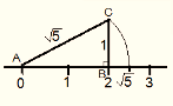
3. Show how √5 can be represented on the number line.

Solution:

Step 1: Let line AB be of 2 unit on a number line.

Step 2: At B, draw a perpendicular line BC of length 1 unit.

Step 3: Join CA

Step 4: Now, ABC is a right angled triangle. Applying Pythagoras theorem,

AB2+BC2 = CA2

22+12 = CA2 = 5

⇒ CA = √5 . Thus, CA is a line of length √5 unit.

Step 4: Taking CA as a radius and A as a center draw an arc touching

the number line. The point at which number line get intersected by

arc is at √5 distance from 0 because it is a radius of the circle

whose center was A.

Thus, √5 is represented on the number line as shown in the figure.

Ncert solution class 9 chapter 1-1

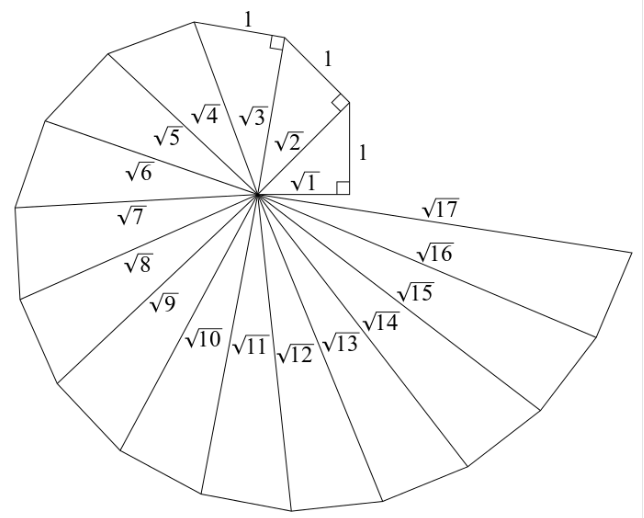
4. Classroom activity (Constructing the ‘square root spiral’) : Take a large sheet of paper and construct the ‘square root spiral’ in the following fashion. Start with a point O and draw a line segment OP1 of unit length. Draw a line segment P1P2 perpendicular to OP1 of unit length (see Fig. 1.9). Now draw a line segment P2P3 perpendicular to OP2. Then draw a line segment P3P4 perpendicular to OP3. Continuing in Fig. 1.9 :

Ncert solution class 9 chapter 1-2

Constructing this manner, you can get the line segment Pn-1Pn by square root spiral drawing a line segment of unit length perpendicular to OPn-1. In this manner, you will have created the points P2, P3,….,Pn,… ., and joined them to create a beautiful spiral depicting √2, √3, √4, …

Solution:

Ncert solution class 9 chapter 1-3

Step 1: Mark a point O on the paper. Here, O will be the center of the square root spiral.

Step 2: From O, draw a straight line, OA, of 1cm horizontally.

Step 3: From A, draw a perpendicular line, AB, of 1 cm.

Step 4: Join OB. Here, OB will be of √2

Step 5: Now, from B, draw a perpendicular line of 1 cm and mark the end point C.

Step 6: Join OC. Here, OC will be of √3

Step 7: Repeat the steps to draw √4, √5, √6….


Exercise 1.3 Page: 14

1. Write the following in decimal form and say what kind of decimal expansion each has :

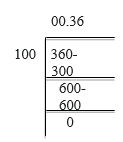
(i) 36/100

Solution:

NCERT Solution For Class 9 Maths Ex-1.3-1

= 0.36 (Terminating)

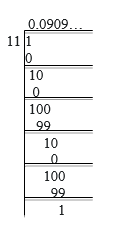
(ii)1/11

Solution:

NCERT Solution For Class 9 Maths Ex-1.3-2

Ncert solution class 9 chapter 1-4

Ncert solution class 9 chapter 1-5

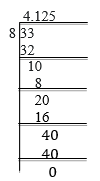
Solution:

Ncert solution class 9 chapter 1-6

NCERT Solution For Class 9 Maths Ex-1.3-3

= 4.125 (Terminating)

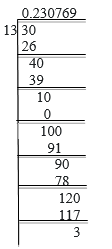
(iv) 3/13

Solution:

NCERT Solution For Class 9 Maths Ex-1.3-4

Ncert solution class 9 chapter 1-7

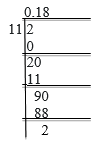
(v) 2/11

Solution:

NCERT Solution For Class 9 Maths Ex-1.3-5

Ncert solution class 9 chapter 1-8

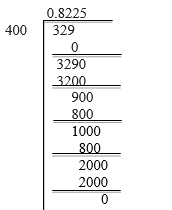
(vi) 329/400

Solution:

NCERT Solution For Class 9 Maths Ex-1.3-6

= 0.8225 (Terminating)

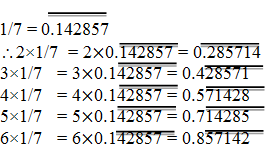
2. You know that 1/7 = 0.142857. Can you predict what the decimal expansions of 2/7, 3/7, 4/7, 5/7, 6/7 are, without actually doing the long division? If so, how?

[Hint: Study the remainders while finding the value of 1/7 carefully.]

Solution:

Ncert solution class 9 chapter 1-9

3. Express the following in the form p/q, where p and q are integers and q 0.

(i) Ncert solution class 9 chapter 1-10

Solution:

Ncert solution class 9 chapter 1-11

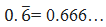
Assume that  x = 0.666…

Then,10x = 6.666…

10x = 6 + x

9x = 6

x = 2/3

(ii) 0.4\overline{7}

Solution:

0.4\overline{7} = 0.4777..

= (4/10)+(0.777/10)

Assume that x = 0.777…

Then, 10x = 7.777…

10x = 7 + x

x = 7/9

(4/10)+(0.777../10) = (4/10)+(7/90) ( x = 7/9 and x = 0.777…0.777…/10 = 7/(9×10) = 7/90 )

= (36/90)+(7/90) = 43/90

Ncert solution class 9 chapter 1-14

Solution:

Ncert solution class 9 chapter 1-15

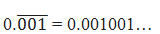
Assume that  x = 0.001001…

Then, 1000x = 1.001001…

1000x = 1 + x

999x = 1

x = 1/999

4. Express 0.99999…. in the form p/q . Are you surprised by your answer? With your teacher and classmates discuss why the answer makes sense.

Solution:

Assume that x = 0.9999…..Eq (a)

Multiplying both sides by 10,

10x = 9.9999…. Eq. (b)

Eq.(b) – Eq.(a), we get

10x = 9.9999

–x = -0.9999…

_____________

9x = 9

x = 1

The difference between 1 and 0.999999 is 0.000001 which is negligible.

Hence, we can conclude that, 0.999 is too much near 1, therefore, 1 as the answer can be justified.

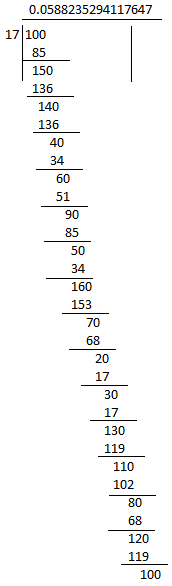
5. What can the maximum number of digits be in the repeating block of digits in the decimal expansion of 1/17 ? Perform the division to check your answer.

Solution:

1/17

Dividing 1 by 17:

NCERT Solution For Class 9 Maths Ex-1.3-7

Ncert solution class 9 chapter 1-16

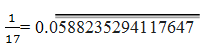
There are 16 digits in the repeating block of the decimal expansion of 1/17.

6. Look at several examples of rational numbers in the form p/q (q ≠ 0), where p and q are integers with no common factors other than 1 and having terminating decimal representations (expansions). Can you guess what property q must satisfy?

Solution:

We observe that when q is 2, 4, 5, 8, 10… Then the decimal expansion is terminating. For example:

1/2 = 0. 5, denominator q = 21

7/8 = 0. 875, denominator q =23

4/5 = 0. 8, denominator q = 51

We can observe that the terminating decimal may be obtained in the situation where prime factorization of the denominator of the given fractions has the power of only 2 or only 5 or both.

7. Write three numbers whose decimal expansions are non-terminating non-recurring.

Solution:

We know that all irrational numbers are non-terminating non-recurring. three numbers with decimal expansions that are non-terminating non-recurring are:

  1. √3 = 1.732050807568
  2. √26 =5.099019513592
  3. √101 = 10.04987562112

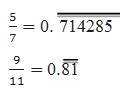
8. Find three different irrational numbers between the rational numbers 5/7 and 9/11.

Solution:

Ncert solution class 9 chapter 1-17

Three different irrational numbers are:

  1. 0.73073007300073000073…
  2. 0.75075007300075000075…
  3. 0.76076007600076000076…

9.  Classify the following numbers as rational or irrational according to their type:

(i)√23

Solution:

√23 = 4.79583152331…

Since the number is non-terminating non-recurring therefore, it is an irrational number.

(ii)√225

Solution:

√225 = 15 = 15/1

Since the number can be represented in p/q form, it is a rational number.

(iii) 0.3796

Solution:

Since the number,0.3796, is terminating, it is a rational number.

(iv) 7.478478

Solution:

The number,7.478478, is non-terminating but recurring, it is a rational number.

(v) 1.101001000100001…

Solution:

Since the number,1.101001000100001…, is non-terminating non-repeating (non-recurring), it is an irrational number.